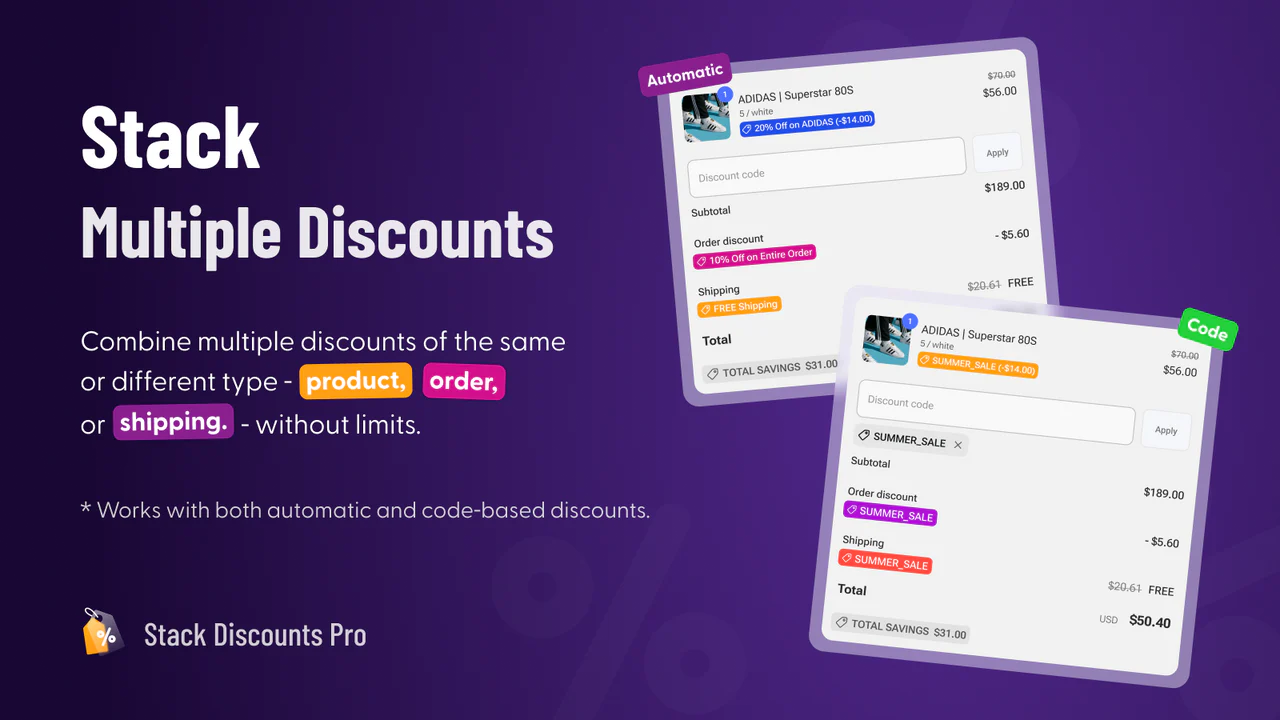
Most checkout pages have a single promo code field. That makes it look like you can only use one discount at a time — but that's not the full picture.
Coupon stacking is the practice of combining multiple discount types on a single purchase to maximize savings. Done correctly, it's completely legitimate and one of the most effective strategies for never paying full price. Done incorrectly, it can get your order cancelled, your account flagged, or your future discount access revoked.
This guide covers which combinations are safe, which retailer policies actually allow stacking, how to layer physical coupons with digital codes, and how grocery stacking works — where the biggest opportunities often live. For the full foundation on using coupons effectively, see our guide on 10 coupon habits that actually work.
Store Policies on Multiple Codes
The single biggest factor in coupon stacking is retailer policy — and it varies more than most shoppers realize.
The one-code rule (most common). The majority of online retailers accept only one promo code per order. Their checkout system has a single code field and will reject a second entry. This doesn't mean stacking is impossible — it means the second layer of savings has to come from a different mechanism than a promo code field.
Explicit stacking policies. Some retailers publish coupon stacking rules in their terms of service. Target's policy, for example, distinguishes between "Target Circle offers" (stackable with one manufacturer coupon) and store-wide promo codes (generally not stackable with each other). Reading the terms page for any retailer you shop at regularly is worth the five minutes.
Where stacking is most permissive:
Target — One Target Circle offer + one manufacturer coupon + Target RedCard 5% discount can all apply to a single transaction, making it one of the most stacking-friendly major retailers
Walmart — Accepts manufacturer coupons alongside its own promotional pricing; cashback applies on top
Amazon — Allows one promo code plus any active Subscribe & Save discount, plus applicable Lightning Deal pricing simultaneously
Sephora — Beauty Insider points, sale pricing, and a single promo code can stack, though exclusions apply frequently
Best Buy — Price-match policy can be applied before a promo code, effectively creating a two-layer discount
Where stacking is most restricted: Luxury brands, electronics manufacturers selling direct (Apple, Sony, Samsung), and flash-sale sites typically prohibit any form of stacking. Their promotional codes override rather than layer.
Safe Stacking Combinations
These combinations are broadly permitted across most major retailers and represent the lowest-risk, highest-reward approaches to using multiple coupons at once. New to promo codes? See what is a promo code and how coupon codes work first.
Promo code + cashback portal. This is the most universally available stack. Apply a promo code at checkout to reduce your total, then have an active cashback session running through Rakuten, TopCashback, or Ibotta. The cashback calculates on your final paid amount — after the code discount. No retailer blocks this combination because the cashback is paid by the affiliate network, not the retailer directly. To auto-find the best code without manual searching, install a browser extension — see our review of extensions that find coupons automatically. For a deeper breakdown of how cashback stacking works, see our cashback vs coupons guide.
Store sale price + manufacturer coupon. When a product is already on sale, a manufacturer coupon (issued by the brand, not the retailer) can often be applied on top. This is particularly common at pharmacy chains, grocery stores, and Target. The key is that a manufacturer coupon is a different instrument from a store coupon — most retailers treat them separately.
Store credit card discount + promo code. Many store credit cards apply their discount automatically as a statement credit or at-the-register reduction — separate from the promo code field entirely. The Target RedCard's 5% is applied at the payment level, not through a code box, meaning it stacks freely with other eligible promotions.
Loyalty points + promo code. Redeeming accumulated points (Sephora Beauty Insider, Best Buy My Best Buy points, etc.) counts as a payment method, not a coupon. Applying points to your order doesn't prevent a separate promo code from working — they operate in different systems.
Free shipping code + percentage-off code (where two-code fields exist). A small number of retailers — typically mid-size e-commerce brands — have two separate fields: one for a promo code and one for a gift card or shipping code. When both fields exist, both codes can be applied. Always look for a secondary field before assuming only one discount is possible.
What Gets Your Account Flagged
There's a clear line between strategic stacking and behavior that retailers classify as abuse. Crossing it can result in order cancellation, coupon access revocation, or — in rare cases — account suspension.
Creating multiple accounts to reuse one-time codes. Welcome codes, first-order discounts, and new-customer offers are the most aggressively monitored discount category. Retailers cross-reference email addresses, shipping addresses, payment methods, and device fingerprints. Using the same shipping address and credit card across three "new" accounts will almost certainly trigger a review. This isn't a gray area — it violates most retailers' terms of service explicitly.
Using leaked employee or affiliate codes. Internal codes meant for staff or affiliates occasionally surface on deal forums. Using them may work once, but the transaction is often reviewed retroactively and can be reversed. The account that used the code is flagged and may lose access to future promotional pricing.
Applying codes to excluded items and disputing the reversal. Using a code on a product category it excludes, then contacting customer service to dispute when the discount is removed, is flagged as bad-faith conduct. Most retailers log support interactions against your account.
Reselling items purchased with stacked discounts at scale. Purchasing large quantities of products using stacked discounts and reselling them is classified as commercial abuse by most retailers. Accounts showing this pattern — frequent large orders with maximum discount stacking — are reviewed and restricted.
What doesn't get you flagged: Using one legitimate promo code per order, activating cashback through a third-party portal, redeeming loyalty points you've earned, and price-matching to a publicly available competitor price. These are all designed-in features of how retailers sell — not workarounds.
Physical Coupons + Digital Codes
The most powerful multiple promo codes checkout strategy available at brick-and-mortar and hybrid retailers is combining a physical manufacturer coupon with a digital store offer.
How it works in-store: Physical manufacturer coupons are issued by the brand (not the retailer) and reduce the amount the retailer charges for a product. At most grocery chains, drug stores, and Target, you can present a physical manufacturer coupon at the register while a digital store offer (loaded onto your loyalty card or app) applies simultaneously.
Example at Target:
A cereal brand has a manufacturer coupon for $1.00 off in the Sunday circular
Target's app shows a Circle offer for $0.50 off the same cereal
You load the Circle offer to your account before checkout
At the register, scan your app (Circle offer applies) and hand over the physical coupon (manufacturer discount applies)
Both reductions appear on your receipt
This combination — one store offer plus one manufacturer coupon — is explicitly permitted by Target and most other major chains. The critical rule: you cannot stack two manufacturer coupons on one item, and you cannot use two store coupons on one item. One of each is the allowed structure.
Translating this to online shopping: The digital equivalent is a brand-issued coupon (found on the manufacturer's own website or apps like Ibotta) applied alongside a retailer's store promotion. When both exist simultaneously, check whether the retailer's checkout system allows the combination — some do through separate discount fields, others don't.
Where to find manufacturer coupons:
Brand websites (often have a "coupons" or "offers" section)
Ibotta and Fetch Rewards apps (digital manufacturer coupons that scan at checkout)
Sunday newspaper inserts (still active and often overlooked)
Coupons.com (aggregates manufacturer coupons for grocery and household products)
If both extensions and coupon databases return nothing for a retailer, see our guide on how to find working codes when nothing else works for deeper sourcing strategies.
Grocery Stacking Explained
Grocery shopping offers more stacking opportunities than almost any other category — because grocery retail is built around a multi-layer coupon ecosystem that has evolved over decades.

The standard grocery stack has four layers:
Layer 1 — Sale price. The retailer's own weekly or rotating promotional pricing. No action required; it's automatic when an item is on sale.
Layer 2 — Store loyalty card offer. Digital or card-loaded offers available through the retailer's app (Kroger, Safeway, CVS ExtraCare, etc.). These are store coupons that require you to load them to your card before checkout.
Layer 3 — Manufacturer coupon. A brand-issued discount, either physical (from a newspaper or mailer) or digital (from Ibotta, Coupons.com, or the brand's own app). Applied separately from the store coupon.
Layer 4 — Cashback app. Apps like Ibotta and Fetch Rewards pay you cashback after the fact when you submit your receipt or link your loyalty card. This applies on top of whatever you paid after the first three layers.
A realistic example: A bottle of laundry detergent normally costs $12.99.
Store has it on sale for $9.99 (Layer 1)
Store loyalty app has a $1.00 off digital coupon (Layer 2, loaded to card)
Brand has a $1.50 off manufacturer coupon in the app (Layer 3)
Ibotta has $0.75 cashback on this product (Layer 4)
Final effective cost: $9.99 − $1.00 − $1.50 = $7.49 at checkout + $0.75 cashback = $6.74 effective price on a $12.99 item. That's a 48% total discount using four legitimately stackable layers.
The grocery category is where serious coupon stackers achieve the highest savings rates — often 30–50% off a full grocery haul when all four layers are applied consistently.
Frequently Asked Questions
Can you use multiple coupons at once at major retailers? It depends on the retailer and the combination. Most online retailers accept one promo code per order, but stacking that code with cashback, loyalty points, or a store credit card discount is broadly permitted. Physical retailers like Target allow one store offer plus one manufacturer coupon on the same item.
What are the coupon stacking rules at Target? Target allows one Target Circle offer plus one manufacturer coupon per item, plus the automatic 5% RedCard discount on the total transaction. Multiple Target Circle offers cannot apply to the same product, and two manufacturer coupons cannot apply to the same product.
Will using multiple discount methods get my account banned? Using legitimately stackable discounts — one promo code, cashback, loyalty points, a store credit card — will not get your account flagged. What triggers reviews is creating multiple accounts to reuse new-customer codes, using leaked internal codes, or purchasing in large quantities for resale.
Can I use multiple promo codes at checkout? Most retailers only allow one code per order. A small number of specialty retailers have two separate discount fields. For most purchases, your second discount layer needs to come from cashback, a loyalty card, or a store credit card rather than a second code.
Is coupon stacking at grocery stores legal? Yes. The manufacturer-plus-store-coupon structure is designed into how grocery retail works. Using one of each per item is the intended and permitted behavior. Apps like Ibotta adding cashback on top is also fully permitted — retailers receive full reimbursement through the app's affiliate and brand partnership model.
Where can I find coupons to stack? Start with verified codes on our store directory, then check manufacturer coupon apps like Ibotta and Coupons.com, and activate cashback through Rakuten before completing any purchase.
Find verified promo codes to stack with your cashback and loyalty rewards — updated daily across hundreds of stores.