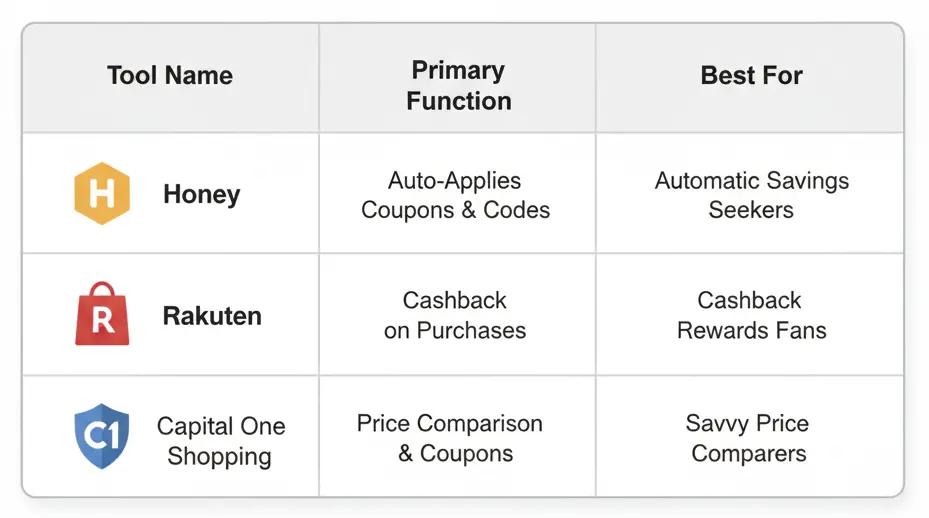
If you have searched "Honey vs Capital One Shopping" in the past six months, you have likely come across more controversy than comparison. That is because the coupon extension space changed dramatically in late 2024 and through 2025 — not due to new features, but due to a series of investigations, lawsuits, and policy changes that reframed how these tools actually work under the hood.
This guide covers what each extension does, how the three compare on the metrics that actually matter to shoppers (coupon success rate, cashback structure, privacy practices, and store coverage), and the specific events in 2025 that any U.S. shopper should know before installing or keeping any of these extensions in 2026.
1. Quick Comparison Table
Honey | Capital One Shopping | Coupert | |
|---|---|---|---|
Owner | PayPal | Capital One | Independent (Hong Kong) |
Coupon auto-apply | Yes | Yes | Yes |
Cashback | Yes (Honey Gold) | Yes (Shopping Credits) | Yes |
Cash payout | PayPal cash or gift cards | Gift cards only — no cash | PayPal cash |
Payout minimum | $10 | Varies | $10 |
Price comparison | Yes | Yes (strongest feature) | Yes |
Price history | Yes | No | Yes |
Browsers | Chrome, Firefox, Edge, Safari | Chrome, Edge only | Chrome, Firefox, Edge |
Active legal issues | Multiple class action lawsuits | Similar lawsuit filed | None known |
User loss (2025) | ~8 million users left | — | — |
Best for | Major mainstream retailers | Price comparison shoppers | Broad + niche store coverage |
2. Honey (PayPal): What It Does — and What Happened in 2025
Honey was founded in 2012 and acquired by PayPal for $4 billion in 2020. For years, it was the default answer to "which coupon extension should I install?" It grew to over 20 million Chrome users, primarily through heavy influencer sponsorship on YouTube — a detail that became central to its downfall.

How Honey works (the intended version)
When you are at a retailer's checkout page, Honey activates and tests available promo codes against your cart. The best working code is applied automatically. You also earn Honey Gold points on purchases at partner merchants, which can be redeemed for gift cards or PayPal cash once you reach a $10 threshold. Additional features include a price history tracker and Droplist, which alerts you when saved items drop in price.
The 2024–2026 controversy: what you need to know
In December 2024, a New Zealand-based YouTuber named MegaLag published an investigative video — eventually viewed over 13 million times — alleging that Honey's extension was quietly replacing affiliate tracking cookies at checkout. The practical consequence: when a consumer clicked an influencer's product link and then activated Honey, Honey received credit for the sale even when it found no coupon. The influencer whose link drove the purchase lost their commission.
The controversy escalated rapidly:
December 29, 2024: Three law firms filed the first class action lawsuit against PayPal in U.S. federal court, with YouTubers from Wendover Productions and Ali Spagnola as named plaintiffs.
January 3, 2025: GamersNexus filed a separate class action through Cotchett, Pitre & McCarthy.
January 2025: Tech influencer Marques Brownlee (19M+ YouTube subscribers) publicly advised viewers to uninstall Honey.
March 2025: Google updated Chrome Web Store policies specifically to prohibit extensions from claiming affiliate commissions without providing discounts — a policy change widely interpreted as targeting Honey's practices.
May 2025: Honey had lost over 4 million users. Similar lawsuits were filed against Microsoft Shopping and Capital One Shopping for allegedly comparable practices.
July 2025: Honey's Chrome user count had dropped from ~20 million to ~14 million.
November 7, 2025: A federal judge denied PayPal's motion to force the class action into arbitration, allowing the case to proceed in federal court.
December 21–30, 2025: MegaLag published two additional videos alleging that Honey scraped and distributed private coupon codes without business consent, collected browsing data from users including minors despite a stated 18+ policy, and embedded code to evade affiliate network detection.
January 12, 2026: PayPal acknowledged the affiliate attribution code and announced it had been disabled. Rakuten Advertising removed Honey from its affiliate network on the same day.
End of 2025: Honey had lost approximately 8 million users in total from its Chrome user base.
PayPal's formal response to the affiliate attribution allegations was that Honey "follows industry rules and practices, including last-click attribution." The lawsuits are ongoing.
What this means for shoppers in 2026
The affiliate attribution issue primarily harmed content creators, not consumers. From a shopper's perspective, the more directly relevant allegation is that merchants could control which coupon codes Honey showed users — meaning Honey may not have always shown you the best available code, but rather the code the merchant approved. PayPal confirmed that merchants do determine which coupons are offered through Honey.
If you are evaluating Honey purely on "does it save me money at checkout," that function is still operational. But the combination of active litigation, 8 million users walking away, and the January 2026 affiliate code acknowledgment represents meaningful reputational and operational uncertainty for a tool that requires browser-level access to your shopping sessions.
3. Capital One Shopping: Strengths, Limitations, and Lawsuit Exposure
Capital One Shopping launched as WikiBuy, an Austin-based startup acquired by Capital One in 2018. It is free for anyone — you do not need a Capital One credit card or bank account. The extension is available on Chrome and Edge but notably absent from Firefox and Safari.
What Capital One Shopping does well
Its price comparison engine is the strongest of the three tools reviewed here. When you are viewing a product on Amazon, for example, Capital One Shopping automatically checks whether the same item is available at a lower price from other retailers or other Amazon sellers. This is genuinely useful, particularly for electronics and home goods where the same product is sold across dozens of retailers at varying prices.
The extension also applies coupon codes at checkout automatically and earns Shopping Credits on purchases at participating retailers. One FinanceBuzz reviewer documented $1,484.27 in combined savings and rewards over two years of use — meaningful value for regular online shoppers.
Capital One Shopping occasionally sends personalized high-value offers to users who have items in their cart (a reported $150 back on a $200 Dyson purchase was cited by one reviewer). These personalized deals, when they trigger, can significantly exceed standard cashback rates.
Limitations that matter
Rewards are gift cards only — no cash. Unlike Honey (PayPal cash option) and Coupert (PayPal cash), Capital One Shopping Shopping Credits cannot be withdrawn as money. You redeem them for gift cards from a rotating selection of retailers. As of late 2025, user reviews on TrustPilot flagged that Lowe's, Home Depot, and Macy's gift card options had been removed from the redemption catalog.
Rewards tracking is inconsistent. Multiple independent reviews and user complaints document rewards remaining in "pending" status for three to four weeks, and some purchases failing to track at all. The Trustpilot rating for capitaloneshopping.com was 1.3 out of 5 stars as of early 2026, with the most common complaint being rewards that were earned but never credited.
Mobile app performance is poor. Multiple reviewers and Google Play ratings note the mobile app crashes or lags, and at least one user reported the extension itself was crashing checkout pages.
Chrome and Edge only. Firefox and Safari users cannot use this extension — a significant limitation for the roughly 30% of desktop users on non-Chrome/Edge browsers.
The lawsuit context
As noted in the Honey section, Capital One Shopping was named in similar affiliate attribution lawsuits filed in 2025, alleging comparable cookie-replacement practices. Capital One Shopping has not acknowledged these practices in the same way PayPal did in January 2026. The litigation is ongoing.
4. Coupert: Performance Data and Honest Trade-offs
Coupert is a browser extension operated by a Hong Kong-based company. It works on Chrome, Firefox, and Edge, and covers retailers globally — not just the U.S. market. Its core mechanism is the same as Honey and Capital One Shopping: detect when you are at checkout, test available coupon codes, and apply the best one. Cashback is earned on qualifying purchases and paid out as real money via PayPal once you hit the $10 threshold.

What distinguishes Coupert's approach
Coupert's code-testing system prioritizes codes ranked by real-time success rates from other users, rather than testing all available codes indiscriminately. The claimed result: fewer failed attempts and a higher proportion of tests that actually result in a discount. Coupert also has direct brand partnerships that unlock private, high-value codes not available in public coupon databases — relevant when shopping at smaller or niche retailers.
Coupert published third-party testing data showing a 72.92% coupon success rate across 100 real checkout scenarios, compared to 33.33% for Honey in the same test. This data is from Coupert's own research, which introduces an obvious bias concern — this is addressed in Section 5 below.
Cashback is paid via PayPal with no quarterly wait — you can request payout whenever your balance reaches $10. This contrasts with Honey Gold (gift cards or PayPal, also $10 minimum, but slower to post) and Capital One Shopping (gift cards only, no cash).
Privacy posture: Coupert states it does not collect or store browsing data beyond what is functionally necessary to apply discounts or trigger cashback, and does not sell data to advertisers. This stated position differs from both Honey (which faced allegations of broader data collection including minor users) and Capital One Shopping (which explicitly collects browsing and search history, which can be sold to retailers and marketing companies per its terms).
Honest trade-offs
Coupert's primary limitations are its smaller brand recognition in the U.S., a less polished UI compared to Honey, and the absence of a price-drop alert feature equivalent to Honey's Droplist. Product Hunt's comparative review notes that "if Honey's main value is 'try codes at checkout,' Coupert is better suited to shoppers who also want to validate whether today's price is actually good before buying" — a framing that captures Coupert's positioning well but also implies it requires more active engagement than Honey's set-and-forget approach.
The 72.92% success rate figure comes from Coupert's own published testing. No fully independent third-party test using identical methodology is available as of publication. Treat this figure as directionally informative rather than a precise verified benchmark.
5. Head-to-Head: Coupon Success Rate
The most important practical question for any coupon extension is: when you are at checkout, how often does it actually find and apply a code that saves you money?
What testing data shows:
Coupert's published test (100 retailers, auto-apply only): 72.92% success rate
Honey in the same test: 33.33% success rate
Capital One Shopping: no comparable published testing data; user reviews indicate it "sometimes finds valid coupons" but "doesn't guarantee savings on every purchase" (The Penny Hoarder, March 2025)
The important caveat: Coupert conducted the test comparing itself to Honey. While the methodology is described in detail and the test covered 100 real stores including both major and niche retailers, independent replication of this specific test has not been published. Additionally, Honey's coupon database has evolved through the controversy period and may have been affected by its removal from Rakuten's affiliate network in January 2026.
What multiple independent sources agree on: Honey's code effectiveness is strongest at large, well-known retailers and less consistent on smaller or niche stores. Coupert's coverage of mid-sized and smaller retailers is noted as a differentiating strength across multiple independent reviews (AARP, DollarSprout, Product Hunt). Capital One Shopping's primary value is price comparison rather than code success.
6. Head-to-Head: Cashback & Rewards Payout
Honey | Capital One Shopping | Coupert | |
|---|---|---|---|
Cashback type | Honey Gold points | Shopping Credits | Cash |
Redemption | Gift cards or PayPal cash | Gift cards only | PayPal cash |
Payout minimum | $10 | Varies by gift card | $10 |
Payout schedule | On demand | On demand (when threshold met) | On demand |
Payout speed | Days to weeks | 3–4 weeks (sometimes longer) | On demand |
Cash option | Yes (PayPal) | No | Yes (PayPal) |
The key distinction: Capital One Shopping does not offer cash. If you want real money rather than gift cards, it is the weakest of the three. For shoppers who regularly use the retailers in Capital One Shopping's gift card catalog, this distinction matters less — but the catalog has narrowed, with major home improvement retailers removed as of late 2025 per user reports.
Honey's Honey Gold redemption timeline is generally faster than Capital One Shopping's reward posting, but both are slower than Coupert's on-demand cash payout. Honey's PayPal integration is its strongest payout feature — if you already use PayPal, redeeming for cash (not gift cards) is seamless.
7. Head-to-Head: Privacy & Data Practices
This is the dimension that changed most dramatically in 2025 and deserves serious consideration before installing any of these extensions.
Honey (PayPal): The most significant privacy-related allegations from the MegaLag investigations include: broader data collection than disclosed (including from minor users), scraping of private coupon codes from businesses without consent, and embedding detection-evasion code in the extension. PayPal acknowledged and disabled the affiliate attribution code in January 2026. PayPal also launched an advertising platform in April 2025 that "leverages transaction data from PayPal, Venmo, and Honey" — which MegaLag summarized as: "PayPal didn't spend $4 billion for a simple coupon extension. They were buying a window into your life as a consumer." Honey's own sign-up terms state it will not sell your data to other companies.
Capital One Shopping: The extension explicitly collects browsing and search history. Its privacy documentation acknowledges this data "can be sold to other large retailers, marketing companies, and big data companies," per multiple independent reviewers. Capital One as a financial institution is subject to federal banking regulations (FCRA, GLBA) that constrain some forms of data use, which may offer greater structural protection than a non-bank company.
Coupert: States it collects only anonymous functional data necessary to apply discounts or trigger cashback, does not sell or share data with advertisers, and is not subject to the affiliate attribution allegations that have driven lawsuits against Honey and Capital One Shopping. As a Hong Kong-based company, it is subject to different regulatory frameworks than U.S.-based companies — a relevant consideration for users who prefer domestic regulatory oversight.
The honest bottom line: All three extensions require browser-level access to your shopping sessions. They can see the pages you visit, the products you view, and the purchases you make. The differences are in how they use and monetize that access. None of these tools is fully "privacy-neutral."
8. Head-to-Head: Store Coverage
Honey | Capital One Shopping | Coupert | |
|---|---|---|---|
Stated retailer count | 30,000+ | 100,000+ | 20,000+ partners |
Large U.S. retailers | Strong | Strong | Strong |
Small/niche stores | Weak | Moderate | Strong |
International stores | Limited | Limited (U.S.-focused) | Strong (global) |
Amazon price comparison | No | Yes | Partial |
Capital One Shopping has the largest stated retailer database at 100,000+ and the best dedicated Amazon-vs-elsewhere price comparison. Honey has strong code coverage for major U.S. retailers but weaker performance at smaller stores — consistent across multiple independent reviews. Coupert's strength at niche and mid-sized retailers is its most-cited differentiator.
9. Who Should Use Which Extension?
Choose Honey if:
You primarily shop at a small set of major U.S. retailers (Amazon, Walmart, Target, Gap, Nike, etc.) where Honey's coverage is strong
You have a PayPal account and want seamless cashout to PayPal cash
You want price-drop alerts and a polished price history interface
You have followed the 2025 controversy and are comfortable with the current state of PayPal's amended practices
Choose Capital One Shopping if:
Price comparison across retailers is your primary use case — this is where Capital One Shopping is genuinely the best of the three
You are okay with gift card-only redemption and the retailers in the current catalog work for you
You primarily shop on Chrome or Edge (not Firefox or Safari)
You want to keep tabs on whether an Amazon price is actually competitive
Choose Coupert if:
You shop across a mix of well-known and smaller/niche retailers
You want cash payout (PayPal), not gift cards
Privacy practices are a priority — Coupert's stated data policy is the most restrictive of the three
You shop at international retailers or want coverage beyond the U.S. market
You are uncomfortable with the ongoing legal situation around Honey or Capital One Shopping
The pragmatic answer for most shoppers: Capital One Shopping for price comparison + Coupert for coupon codes covers most scenarios without the active litigation exposure that Honey currently carries. This combination runs on Chrome simultaneously without known conflicts.
10. Can You Run Multiple Extensions at Once?
Yes, technically. Most shoppers who run multiple extensions do so because the tools serve different purposes: one for coupon codes, one for cashback, one for price comparison.
Practical considerations:
Running Honey and Capital One Shopping simultaneously has known conflict risks — if both try to apply codes at checkout, results can be unpredictable. User reports note that having multiple coupon extensions active can cause one to override or interfere with the other.
Coupert and Capital One Shopping can be run simultaneously with less reported conflict, since they are less likely to compete at the same moment of the checkout process.
If you are using a cashback portal like Rakuten alongside a coupon extension, the coupon code may reduce your cashback (since cashback is calculated on the purchase total after discounts). For small codes ($5 off), skipping the code and keeping the cashback active often produces better net savings.
One extension worth knowing alongside these three: Kudos is a separate extension that identifies which credit card in your wallet earns the most rewards at the store you are shopping. It does not conflict with coupon extensions and adds a further savings layer that none of the three tools above covers.
11. Frequently Asked Questions
Do I need a Capital One credit card to use Capital One Shopping? No. Capital One Shopping is free for anyone regardless of whether you have a Capital One credit card or bank account. Capital One cardholders may occasionally see exclusive promotional offers, but the core functionality is available to all users.
Is Honey still safe to use after the 2025 controversy? Honey is still operational and still finds coupon codes. PayPal acknowledged and disabled the specific affiliate attribution code in January 2026. The lawsuits are ongoing, but none of the current legal proceedings restrict consumer use of the extension. The more relevant concern for shoppers is the allegation that merchants control which codes Honey shows — meaning you may not always see the best available code. For a tool where the core promise is "find the best deal," this is a meaningful functional limitation.
Can Coupert be trusted as a Hong Kong-based company? Coupert's stated data practices are more restrictive than either Honey or Capital One Shopping. The fact that it is not a U.S. company means it is not subject to U.S. consumer financial regulations, which some users may view as a limitation. It is not subject to the same FCRA or GLBA constraints that Capital One's data handling falls under. No significant investigative allegations or lawsuits comparable to those targeting Honey have been filed against Coupert as of publication.
Which extension is best for Amazon shopping specifically? Capital One Shopping is the strongest tool for Amazon specifically, because its price comparison engine checks whether a product you are viewing on Amazon is available cheaper elsewhere or from another Amazon seller. None of the three extensions apply third-party coupon codes on Amazon.com itself (Amazon restricts external coupon code use on its platform), but Capital One Shopping's comparison tool provides genuine value for Amazon shoppers.
Does using a coupon code reduce my cashback? At most cashback portals, yes — cashback is calculated on the final purchase amount after discounts. A 20% off coupon on a $100 item reduces your cashback from (say) 5% of $100 ($5) to 5% of $80 ($4). For deep coupon codes (20%+), taking the code is typically still better net savings. For small codes ($2–3 off), the cashback may exceed the code value and you are better off skipping the code.
Sources
Wikipedia — PayPal Honey (updated February 2026, covers full controversy timeline) en.wikipedia.org/wiki/PayPal_Honey
Cohen Milstein — In Re PayPal Honey Browser Extension Litigation (January 2025) cohenmilstein.com
Digiday — The Honey scandal is a 'wake-up call' for the creator industry (February 2025) digiday.com
PPC.land — Honey Collected Minor Data and Leaked Business Codes Without Consent (December 2025) ppc.land
FinanceBuzz — Capital One Shopping Review (October 2025) financebuzz.com
The Penny Hoarder — Capital One Shopping Review (March 2025) thepennyhoarder.com
Coupert — Coupert vs Honey: Performance Test Across 100 Stores (June 2025) coupert.com (Note: conducted by Coupert; treat as directionally informative, not independently verified)
Product Hunt — Best Honey Alternatives 2026 producthunt.com
Kudos Blog — Rakuten vs Honey vs Capital One Shopping (2026 Guide) joinkudos.com
AARP — 4 Browser Extensions to Save You Money Online (June 2025) aarp.org
⚠️ Transparency: PureCouponCodes earns affiliate commissions on some retailer links on this site. This comparison article does not contain affiliate links to the extensions reviewed. Litigation against Honey and Capital One Shopping is ongoing; this article reflects information available as of April 2026 and will be updated as developments warrant.